
At first glance, a mint mark may look like nothing more than a tiny letter on a coin. That small detail can reveal where the coin was made, connect it to a specific period in American history, and sometimes make a major difference in how coin collectors view its rarity and value.
For anyone interested in U.S. coins, learning how to recognize mint marks is an important part of understanding what makes one coin different from another. Two coins may share the same date and design yet have very different stories because they were produced at different mint facilities.
What Is a Mint Mark?
A mint mark is a letter placed on a coin to show which United States Mint facility produced it. The location of the mark varies depending on the coin, its denomination, and the year it was struck.
Some mint marks appear close to the date on the front of the coin. Others may be found on the reverse, often near the bottom of the design or beneath an eagle, wreath, or other image.
Not every U.S. coin has a mint mark. For many years, coins made at the Philadelphia Mint did not display one. As a result, the absence of a mint mark can sometimes be just as important as the presence of one.
The Philadelphia Mint
The Philadelphia Mint was established in 1792 and was the first official mint facility in the United States. Because it was the original location, Philadelphia coins traditionally did not carry a mint mark.
Today, many coins made in Philadelphia display a “P,” although there are still exceptions. Collectors should never assume that a coin without a mint mark is rare. In many cases, it simply means the coin was struck in Philadelphia.
Even so, Philadelphia played a central role in the development of American coinage. Many of the earliest U.S. coins were produced there, making the facility an important part of the nation’s monetary history.
The Denver Mint
Coins marked with a “D” were made at the Denver Mint, which began producing coins in 1906.
Denver remains one of the country’s busiest mint facilities and produces large quantities of circulating coins. Because of this, many modern coins with a “D” mint mark are common.
However, not every Denver coin is easy to find. Certain years had lower production totals, and some date and mint mark combinations are much more desirable than others. Condition also matters. A well-preserved Denver coin may attract more collector interest than a heavily worn example from the same year.
The San Francisco Mint
The “S” mint mark identifies coins made at the San Francisco Mint.
San Francisco became an important minting location during the California Gold Rush, when large amounts of precious metal were entering the region. Over time, the facility produced many gold and silver coins as well as coins for everyday circulation.
Today, San Francisco is best known for producing proof coins and special collector issues. Proof coins are made with specially prepared dies and planchets, giving them sharper details and highly polished surfaces.
Because many modern San Francisco coins are created specifically for collectors, they are often found in proof sets rather than loose in circulation.
The West Point Mint
A “W” mint mark means a coin was produced at the West Point Mint in New York.
West Point has long been associated with bullion and precious metal coins, including American Eagle issues. It also produces commemorative coins and other special releases.
In recent years, the U.S. Mint has released a limited number of circulating coins with the “W” mint mark. These releases created excitement among collectors because they gave people a chance to discover a relatively scarce coin in everyday change.
West Point coins show how mint marks can turn an ordinary search through pocket change into something much more interesting.
Historic U.S. Mint Locations
Several former U.S. Mint facilities are no longer active, but the coins they produced remain popular with collectors.
The Carson City Mint used the “CC” mint mark and is closely connected to the silver boom in Nevada. It operated for a relatively limited period, and many Carson City coins are highly sought after today.
The New Orleans Mint used an “O” mint mark. It produced a variety of gold and silver coins during the 1800s and early 1900s.
Coins from the Dahlonega Mint carry a “D,” while coins from the Charlotte Mint use a “C.” Both facilities were established to handle gold discovered in the southern United States. Since Denver also uses a “D,” collectors must consider the coin’s date and type to determine which mint produced it.
These historic facilities give collectors a direct connection to regional events, mining discoveries, and economic changes from different parts of the country.
Why Mint Marks Can Affect Value
Mint marks matter because different facilities did not always produce the same number of coins.
One mint may have struck millions of a particular coin, while another produced only a small amount. When fewer coins were made at a location, surviving examples may be harder to find.
Collectors often build sets that include every date and mint mark combination within a certain coin series. A single scarce mint mark may be the most difficult part of completing the set.
However, a mint mark does not determine value by itself. Coin value is also influenced by condition, collector demand, historical significance, metal content, and the number of surviving examples.
Mint Marks and Condition
A scarce mint mark can make a coin more interesting, but condition still plays an important role.
Collectors look at the amount of wear, the sharpness of the details, surface marks, original color, and remaining luster. A coin that has been cleaned, scratched, or damaged may be worth less than an untouched example.
This is one reason owners should avoid cleaning old coins. Cleaning can remove original surfaces and leave behind scratches or unnatural color. Even when the goal is to improve the coin’s appearance, the result may reduce its appeal to collectors.
The Importance of Careful Identification
Mint marks are often very small, and they can be difficult to read on worn coins. Dirt, toning, or damage may also hide important details.
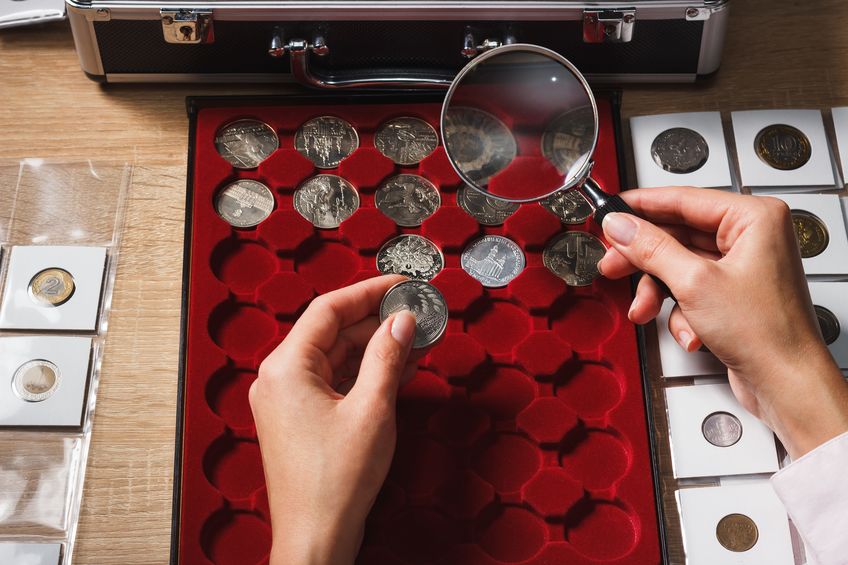
A magnifying glass and good lighting can help, but identification is not always simple. Some coins also have varieties that involve repunched, misplaced, or unusual mint marks.
Professional evaluation can be especially helpful for inherited collections. A group of coins that appear ordinary may contain a scarcer date or mint mark combination that is easy to miss without experience.
A Small Mark with a Big History
Mint marks help transform coins from simple pieces of currency into historical objects. They show where a coin began its journey and connect it to the people, industries, and events surrounding the mint where it was made.
Whether a coin came from Philadelphia, Denver, San Francisco, West Point, Carson City, or another historic facility, its mint mark adds another layer to its story.
At Centennial Auctions, experienced professionals can help collectors, families, estate representatives, and administrators better understand the coins in their possession. A careful appraisal can identify important mint marks, evaluate condition, and provide a clearer picture of a collection’s potential value. Contact Centennial Auctions at 603-356-5765 today or visit us online for more information!